
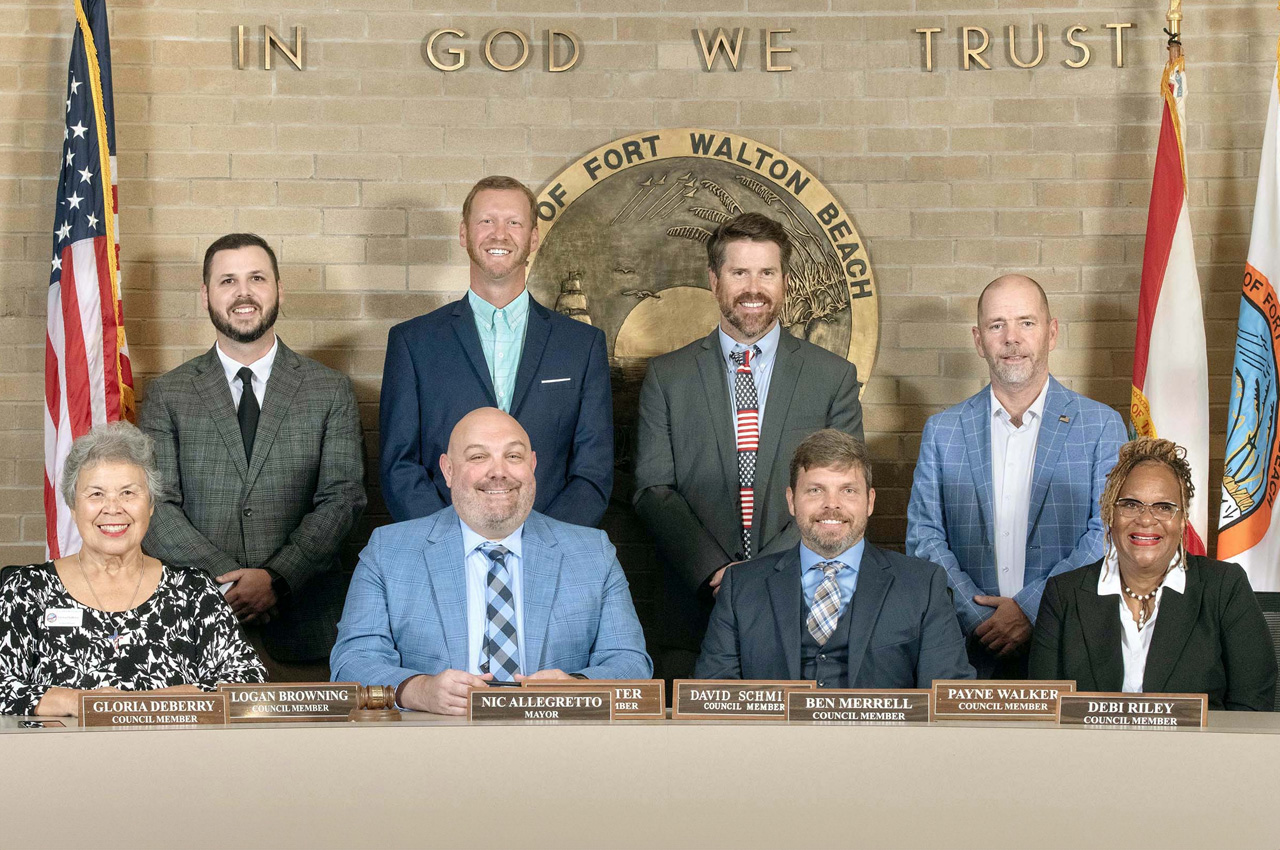
The Fort Walton Beach City Council voted unanimously Tuesday night to form a study group exploring a shift to a hybrid form of government, following a proposal from the NAACP Okaloosa County Branch that argues the change would improve representation for underserved neighborhoods.
- Sabu Williams, president of the NAACP’s local branch, presented the proposal during the Oct. 28 council meeting, emphasizing that the request was not about race or party politics but about ensuring all city neighborhoods have dedicated representation.
“Our proposal is not about race or party, rather, it is about representation,” Williams told the council.
The city currently operates under a council-manager system where all seven council members and the mayor are elected at-large, meaning every voter in the city casts ballots for each seat. The NAACP’s written proposal suggested one possible configuration of four district-based seats and three at-large seats plus the mayor, who would continue to be elected citywide, though Williams emphasized this was just a recommendation for the study group to consider.
- “There’s different ways that you can form a hybrid system. It could be a three-four, it could be five-two, it could be all seven,” Williams said. “We may have a suggestion that says it’s three-four, but that suggestion, it’s just a suggestion on our part.”
Williams said a hybrid model would balance neighborhood advocacy with citywide strategy while preserving the city’s professional management structure through an appointed city manager.
“Having a voice that they can go to – one of you council members that they can talk to prior to coming here – can give them some hope, can even give them some answers,” Williams said, noting that residents often struggle to articulate issues at public meetings.
The proposal cites Fort Walton Beach’s demographic composition as part of the justification for the change. According to 2023 census estimates included in the document, the city’s population of approximately 21,000 is 64.8% white non-Hispanic, 12.5% Black or African American, 11.5% Hispanic, and 5.2% Asian. The city’s poverty rate of 13.8% exceeds both Crestview and Okaloosa County averages.
- Williams pointed to nearby cities that have adopted similar structures. Crestview switched to a system combining precinct-based and at-large council members in 2018, while Apalachicola uses a hybrid model with two district seats and three at-large positions.
Under the current at-large system, Williams noted, all council members could theoretically come from the same neighborhood, leaving some areas without direct representation.
“You could actually have seven council members coming from the same neighborhood,” Williams said. “That’s just a fact. It may not be happening, but it can happen.”
Mayor Nic Allegretto acknowledged the potential benefits of geographic representation, noting that he was “pretty sure” that of the eight that normally sit on the dais, “six of us live in the same neighborhood.”
Allegretto pointed to former councilman Kirby Locklear as an example, saying Locklear frequently advocated for the Kenwood neighborhood where he lived. People in that neighborhood knew they could approach him about local issues because he represented their area, the mayor said.
- The mayor expressed concern about enforcing residency requirements, citing past issues with candidates who didn’t actually live in the city. However, he said the idea was worth exploring.
Williams told the council the NAACP had prepared a petition drive to force the issue onto the ballot but chose instead to seek city leadership on the process.
“I just think that would be forcing things on people versus having people have an opportunity to have input,” Williams said.
The NAACP’s proposal outlines an 18-month implementation timeline that would include forming a study group with neutral experts, conducting community workshops, drafting a charter amendment, holding public hearings, and placing the measure on a ballot for voter approval.
Councilman David Schmidt made the motion to work with the NAACP to form a study group with neutral experts and a phased timeline. The motion called for the city to organize the process, with Schmidt noting the city would be leaning heavily on the mayor to work with the city attorney and city manager, coordinating with NAACP designees.
- Councilwoman Debi Riley seconded the motion and stressed the importance of public education throughout the process.
Councilman Bryce Jeter supported the collaborative approach, saying any opportunity to bring the community together for discussion on important governance issues was worthwhile.
The study group will work with the city manager, city attorney, and mayor to determine initial steps. No timeline was established for when the group might present findings to the council.





4 Responses
DEI at its finest. Treat the city as a whole. Don’t color code it people. This is exactly what causes racism. Stirring the pot isn’t city government. Stupid ideas.
Yes, it is DEI at its finest. Refusing to acknowledge the disparity between different races is ignorant. As a woman, you also fall into those protected by DEI. Education is power, my friend.
Explain the disparities. What can one race do that another cannot? What makes sense about giving racial preference to make up for racial preference?
I totally agree with you.