Fort Walton Beach’s City Manager has released an internal analysis detailing what he describes as operational impacts from a voter-approved spending cap, including delayed vehicle repairs and canceled community programs.
- “I want to take a neutral stance here and simply share data related to the 3% cap on operations,” City Manager Jason Davis wrote in an email accompanying the analysis. “I am in no way taking a personal stance suggesting the 3% cap is good or bad — merely sharing the actual impact.”
The assessment comes as the FWB Watch Group has filed suit challenging the ballot language for five of six charter amendment questions on the March 10 referendum, including one asking voters to repeal the cap.
What voters approved in 2024
In November 2024, Fort Walton Beach voters approved a charter amendment limiting the city’s personnel across all funds and operating expenditures in the General Fund. The cap restricts annual budget increases to whichever is less: 3% or the change in the Consumer Price Index.
The city can exceed that limit only with voter approval in a referendum. The charter allows exceptions for emergencies, grants, gifts and special assessments.
The same election also prohibited elected officials from receiving compensation beyond expense reimbursement.
What voters will see in March
The March 10 municipal election includes six ballot questions on charter amendments:
Ballot Question 1 — Moving City Elections to November General Election Dates: Shall the City Charter be amended to move the election dates for the mayor and city council to coincide with the November statewide general election cycle, which occurs in even years?
Ballot Question 2 — Non-partisan City Elections, Stricter Term Limits, Filling Vacancies, and Filing Fees: Shall Sections 3, 4, 5, 7, and 25 of the City Charter be amended for purposes of clarifying the non-partisan nature of council seats, updating term-limit provisions, establishing consistent procedures for filling council and mayoral vacancies, and providing flexibility in the establishment of filing fees for city elections?
Ballot Question 3 — Council Meetings and Governance: Shall Sections 6, 8, and 9 of the City Charter be amended to clarify procedures for scheduling Council meetings by resolution, to adjust the disciplinary vote threshold for Councilmembers, and to strengthen attendance and forfeiture of office provisions?
Ballot Question 4 — Changes to remove outdated language and enhance efficiency of City Operations: Shall the City Charter provisions relating to city officers and their duties be amended to eliminate outdated language, provide clearer descriptions, and enhance the efficiency of the City’s daily operations?
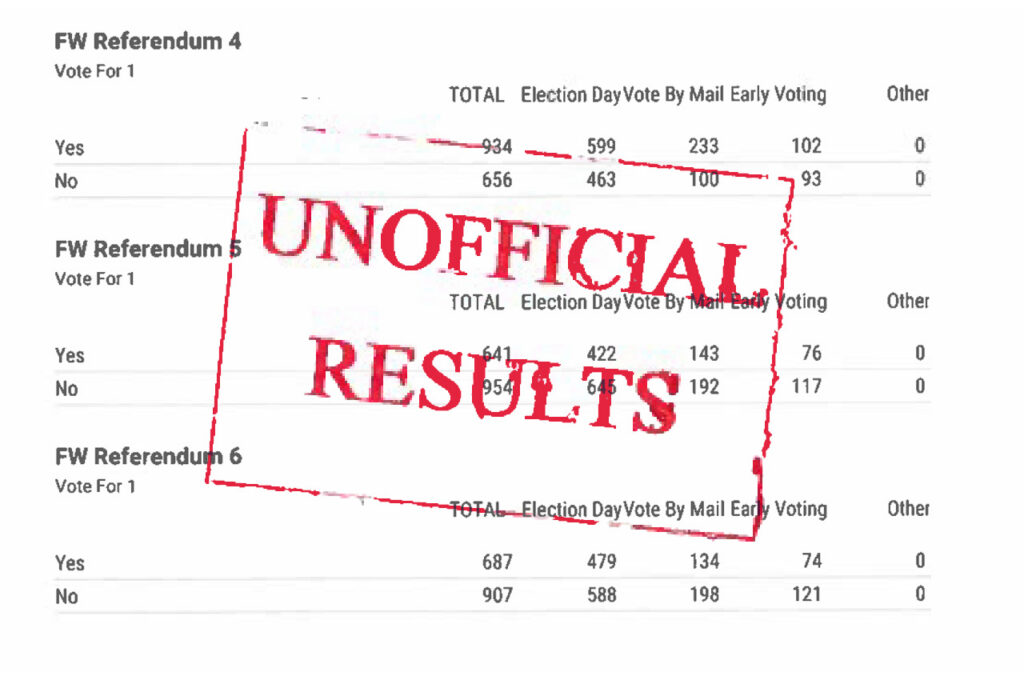
Ballot Question 5 — Authorizing Compensation to City Elected Officials: Shall Section 33 of the City Charter be amended to authorize compensation to city elected officials, with such compensation in the form of either monetary compensation or health insurance coverage to be paid by the City, at the option of the City elected official?
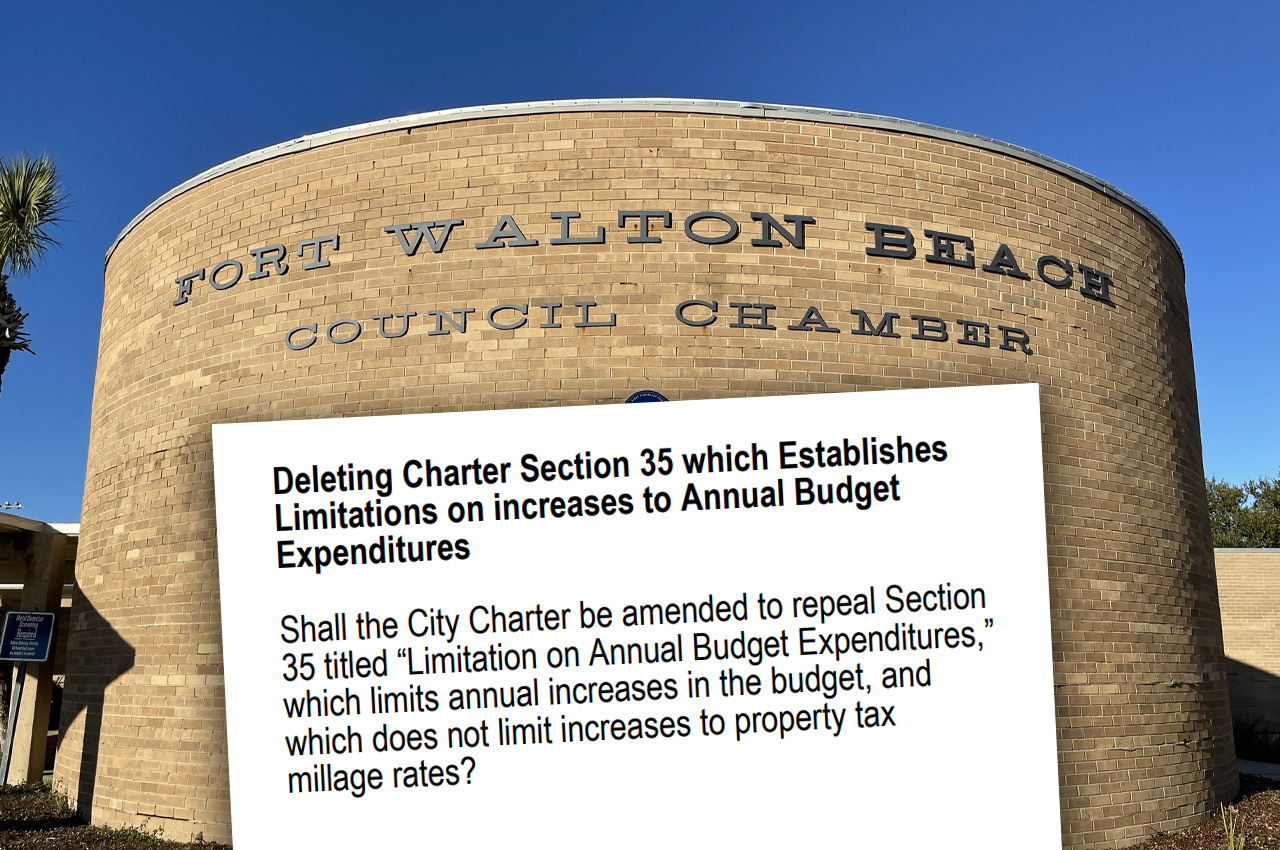
Ballot Question 6 — Deleting Charter Section 35 which Establishes Limitations on increases to Annual Budget Expenditures: Shall the City Charter be amended to repeal Section 35 titled ‘Limitation on Annual Budget Expenditures’, which limits annual increases in the budget, and which does not limit increases to property tax millage rates?
- A “yes” vote would eliminate the spending cap entirely. A “no” vote would keep it in place.
The City Council adopted the ballot language on Dec. 16, 2025. City Attorney Jeff Burns presented the ordinance.
Rob Smith, current chairman of FWB Watch Group and a member of the Charter Review Commission that developed the proposed amendments, appeared at the meeting and objected that the ballot questions were “generic and ambiguous” and did not comply with Florida Statute 101.161, which requires ballot language to state the “chief purpose” of a measure in “clear and unambiguous language,” according to the meeting record.
City manager’s analysis
Davis said he was unfamiliar with spending caps on local government when he interviewed for the Fort Walton Beach job.
“Oddly enough, I had a few colleagues from ICMA suggest I avoid the job because of the cap, but I was not wholly familiar with what the actual impact would be,” Davis wrote, referring to the International City/County Management Association.
- Davis said his understanding is that Marco Island and Palm Bay “also had similar caps and were reworking their charters due to the impacts on their operation.”
His white paper, titled “True Impacts of a 3% Cap,” outlines what he describes as unintended consequences observed over six months of operating under the restriction.
‘Use it or lose it’ spending: Because the cap is calculated on actual expenditures rather than budgeted amounts, departments that spend less than their budget will have a lower cap the following year, according to the white paper. “Now sections must spend all of their annual budgets or risk the 3% cap decreasing their ability to operate in future level of service budgets,” Davis wrote.
- “A bigger concern is tied to the ‘actuals’ expenditure logic,” Davis wrote in his email. “If we do not spend every dollar of the budget, obviously our actual expenditures decrease. The cap is related to actual expenditures for the year — so our budget could decrease every year if we do not forcefully spend the allotments in full.”
Canceled programs and delayed repairs: The city canceled its annual Fire Outreach program, which costs $5,000 and educates citizens on fire safety, “to see how the fiscal year shapes out,” the white paper states. One police vehicle and several golf carts are not being repaired “until later in the fiscal year in order to gauge resources.”
Capped youth sports and programs: Youth sports league participation “is capped due to budget restrictions,” resulting in “turning away kids,” according to the white paper. Senior and community programs cannot expand “without exceeding the allowed expenditure ratio.”
Golf course constraints: The municipal golf course’s pro shop merchandise is capped at $100,000, meaning “the pro shop will run out of several items before the midway point of the fiscal year,” the white paper states. Vendor fitting events that generate revenue have been canceled because the items cannot be purchased under the cap. Range balls “are expected to be exhausted well before the end of the fiscal year resulting in a loss of $900-$1,500 per day of lost range revenue.”
Outsourcing workarounds: The utilities department outsourced a position that cost less than $100,000 including benefits, according to the white paper. The contracted replacement cost $200,000 but was not subject to the cap because Enterprise Fund operations are excluded.
Administrative burden: Navigating a state requirement to spend $5 per photo enforcement violation on school crossing guard programs “took several hours of time from the Chief of Police, Finance, and the City Attorney,” the white paper states. A $10,000 grant to host an intern required analysis “to see the impact based on salary operating expectations for the remainder of the year.” More than $100,000 in tree mitigation funds “is sitting until we have a better grasp of end-of-year budget.”
Lost revenue opportunities: The Growth Management department “identified a means to generate approximately $170k in missing revenues, but the service cannot be procured due to the cap,” the white paper states.
“On paper the 3% cap sounds like a means to save taxpayers’ dollars; however, in actuality it is only serving to drive inefficient and ineffective use of resources,” Davis wrote. “Logic suggests if this cap approach was effective every government operation would implement such a cap.”
Davis said he plans to share the white paper with the Florida City and County Management Association and ICMA “so other local governments have some data to support their decision(s).”
- “This paper hopefully serves as an education instrument,” Davis wrote.
Council member’s perspective
Councilman Ben Merrell, who co-owns Power Up Watersports, tour boats and Soundside Waterfront Bar with his wife, has served 10 months on the council. He posted his assessment of the cap on social media Jan. 28.
“I’m not a government guy, I like to think I’m more of a business guy,” Merrell wrote.
He used a boat rental business to illustrate the cap’s impact: “If I had 10 boats for rent and could only raise my prices 3% each year but one year gas jumped 10% what would I do? I might sell a boat or I might layoff an employee. Same next year and the next. Minimum wage goes up, parts are up so I sell more boats to make it up. 10 years later my last two rundown boats are sold off as part of the bankruptcy settlement … you get the picture. There is no world where this works.”
Merrell wrote that core city costs such as insurance, utilities, labor, maintenance and materials “routinely rise faster than 3%, turning the cap into an automatic cut every year.”
- “There is no direct or indirect savings to the taxpayer that occurs simply because of this cap,” Merrell wrote. “What it does create is waste and inefficiency.”
“We have already seen real life examples where we spent twice as much out of a fund not capped because the operating budget was limited by the 3%,” Merrell wrote. “$100k wasted simply because the current cap forced a work around.”
Merrell described the policy as “self-cannibalizing.”
“Some departments have fixed costs that rise well above 3% and cannot be reduced,” he wrote. “To survive, they pull funding from other departments that can absorb cuts in the short term. Those departments shrink year after year until they are gone, at which point the remaining departments turn inward and begin cutting themselves.”
Merrell also referenced “a group out there saying that the ‘corrupt city council’ is not respecting the will of the voters.”
- “As I have had the privilege to sit on city council the last 10 months I believe that most residents of Fort Walton Beach do not want to see the city dissolved into the county and that’s who I will continue to represent,” Merrell wrote.
The legal challenge
FWB Watch Group, a political committee, and Travis Smith, a former Fort Walton Beach City Councilman, filed suit Jan. 14 in Okaloosa County Circuit Court.
The lawsuit names the city, City Clerk Kim M. Barnes and Supervisor of Elections Paul Lux as defendants.
The complaint challenges ballot language for five of the six charter amendment ordinances adopted Dec. 16, arguing they violate Florida Statute 101.161, which requires ballot questions to provide “clear and unambiguous” explanatory statements of a measure’s “chief purpose” in no more than 75 words. The lawsuit does not challenge Ballot Question 1, which would move city elections to coincide with the November general election cycle.
Regarding the 3% cap question, the lawsuit argues the ballot language “does not explain what Section 35 actually does” and “does not inform voters that Section 35 imposes a spending cap tied to the lesser of three percent or CPI on defined categories of ‘limited expenditures,’ or that its repeal will remove that City Charter-level cap and allow budgeted expenditures to grow at any rate without referendum.”
The lawsuit takes particular issue with the ballot language stating the cap “does not limit increases to property tax millage rates.”
- “Nothing in the text of City Charter Section 35 refers to property tax millage rates at all; it regulates specified expenditure categories, not millage,” the complaint states. “By juxtaposing the repeal of Section 35 with the assertion that it ‘does not limit’ millage increases, the question implies that Section 35 is somehow ineffective or irrelevant to tax burdens, when in fact removing the cap on expenditures could increase pressure for higher millage rates in future budgets.”
The lawsuit also challenges ballot questions addressing council elections and term limits, council meetings and governance, city operations, and compensation for elected officials.
The plaintiffs ask the court to declare all five challenged ballot questions defective and block them from appearing on the March 10 ballot in their current form. They have requested an expedited hearing.
- Alternatively, if an election is conducted before final judgment, the plaintiffs ask the court to declare any referendum held on those questions void and prevent the city from certifying or implementing the results.
“This is why a hard operating cap like this does not exist in thriving municipalities,” added Merrell. “It does not eliminate waste. It systematically erodes the foundations that allow a city to function, govern itself, and thrive.”