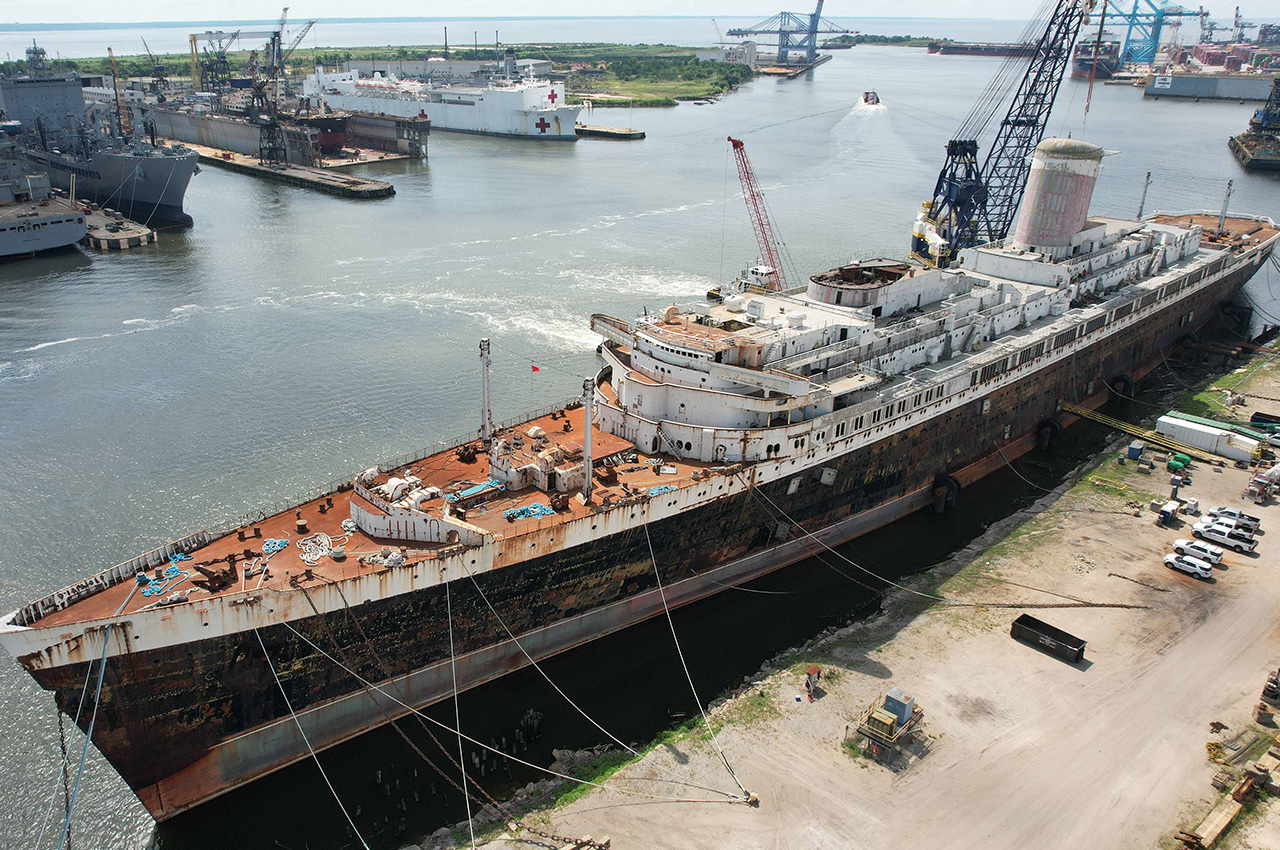
Okaloosa County Commissioners unanimously approved a $2.95 million contract amendment Tuesday to complete the remediation and deployment of the SS United States as the world’s largest artificial reef, with officials emphasizing that partner contributions totaling more than $4 million will offset the additional costs. No additional Okaloosa County funds proposed in this amendment.
- Alex Fogg, the county’s Natural Resources Chief, presented a detailed project update before requesting the funding increase, outlining both the progress made and the challenges encountered in preparing the 990-foot historic ocean liner for its new life in the Gulf.
Fogg explained that approximately $2.2 million of the $2.95 million request stems from unexpected but necessary overruns when planning to depart Philadelphia, with the remainder covering additional needs to reach the finish line, including dockage through June 1 and contingency funds.
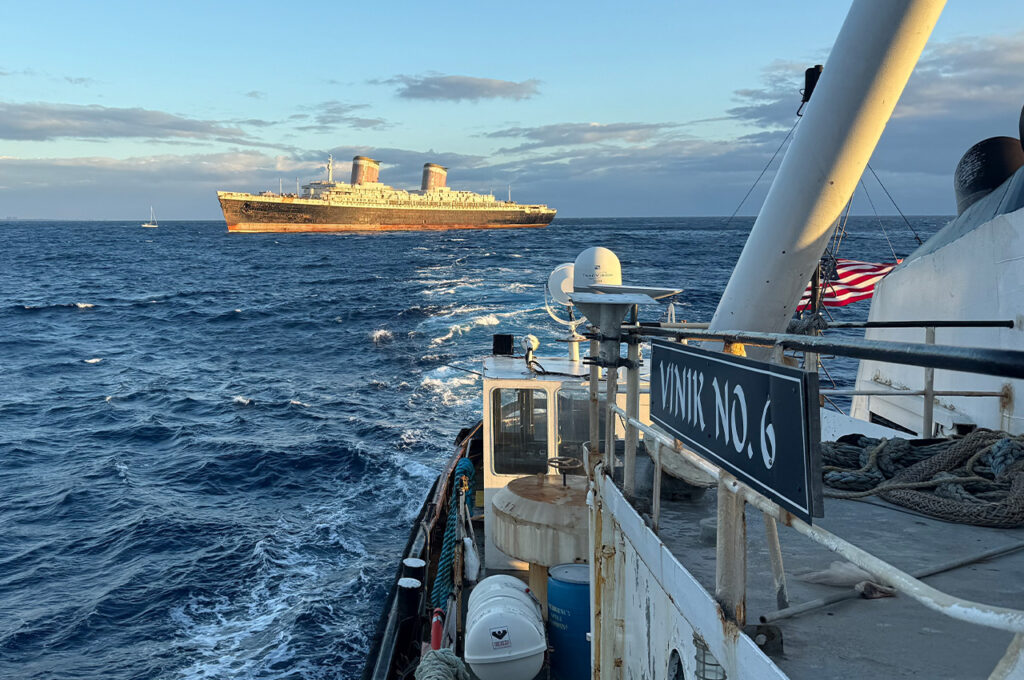
The vessel, which still holds the transatlantic speed record more than 70 years after its maiden voyage, is currently docked in Mobile, Alabama, undergoing final remediation following a 1,600-mile tow from Philadelphia that took approximately 12 days.
Extensive remediation work nearing completion
Fogg reported that the project has made substantial progress on multiple fronts. All 120 fuel tanks aboard the ship have been emptied and cleaned, with at least 50% certified as gas-free as of last week. Additionally, 99% of PCB-containing materials, including wiring, flange gaskets in the ventilation systems and green Neotex decking, have been removed and remediated.
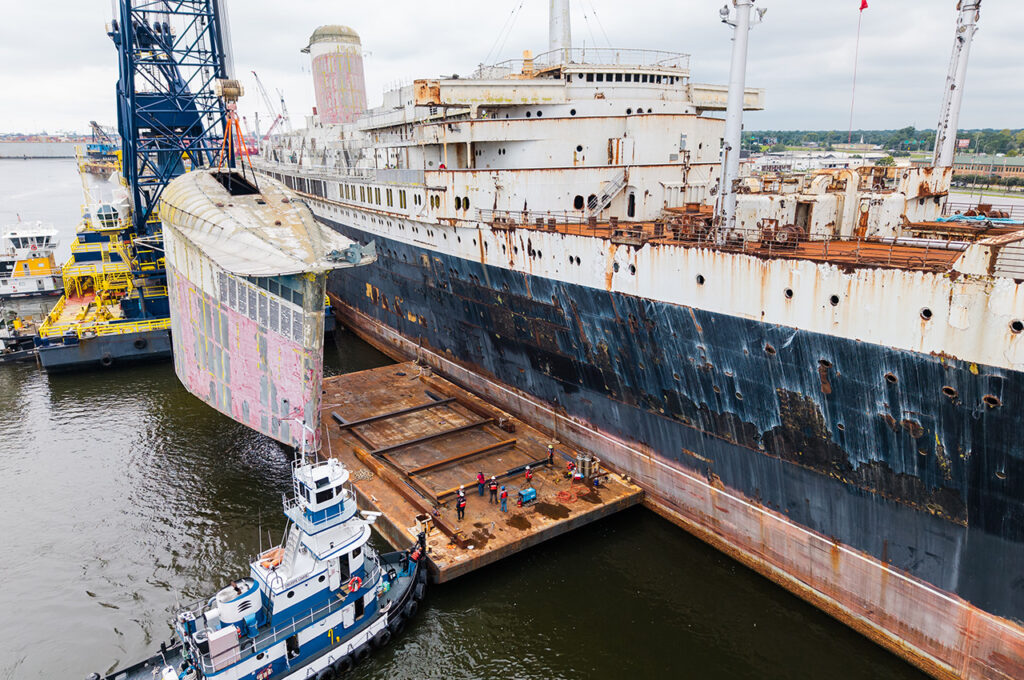
Both of the ship’s iconic funnels, radar mast and five-blade propeller were removed several months ago and transported to a waterside staging facility about 10 miles away. They will eventually be brought to Destin-Fort Walton Beach for the land-based museum being developed in partnership with the SS United States Conservancy.
- “All of the portholes and windows have been removed,” Fogg said. “The portholes have been transported to Okaloosa County, but those needed to be removed because they actually had a gasket within the porthole that had to come off for remediation purposes.”
He added that all exfoliating paint throughout the ship, whether on the exterior or interior, has been scraped off, vacuumed and transported to appropriate disposal facilities.
“As of last week, 80% of the ship is completed and ready for final inspections. It’s probably well over 90% as of this moment,” Fogg said.
Unexpected costs drove budget increase
Fogg outlined several factors that contributed to the cost overruns, saying they were largely beyond the county’s or contractor’s control.
Additional dockage costs accumulated in Philadelphia due to extended surveys and regulatory requirements. The outbound tugs required by the U.S. Coast Guard were more expensive and more numerous than originally planned or used in similar vessel tows.
Tow and pollution insurance costs increased substantially due to other maritime accidents that occurred around the same time, Fogg explained. Fuel surcharges added to expenses, and the Coast Guard required a shadow tug to accompany the vessel through the Florida Keys National Marine Sanctuary, a requirement that was not discussed prior to the actual tow.
- “If we did not approve this and we abandoned the artificial reef project, the only real option would be for the vessel to be scrapped,” Fogg told commissioners. “It’s been dismantled to a point where it’s not going to be a museum anymore. It’s not going to be towed to Miami or other destinations to be a museum.”
Partnership contributions exceed cost overruns
Commissioner Sherri Cox emphasized during the discussion that the funds raised for the project, to date, exceed the amendment request by more than $1 million, meaning there would be no impact on citizens except for the benefit of the project moving forward.
Fogg confirmed that while the amendment totals $2.95 million, the county has raised more than $4 million in partnership funds for the project.
The project has secured contributions from multiple partners.
- The Florida Fish and Wildlife Foundation donated $2 million.
- Visit Pensacola committed $1.5 million, with $1 million going toward construction and $500,000 for marketing.
- The Coastal Conservation Association contributed $500,000, which Fogg noted is the largest single donation in CCA Florida’s 40-year history.
Force Blue, an organization that redirects retired special forces operators toward marine conservation, will cover security and safety costs associated with the deployment. NAUI Worldwide, a scuba diving training organization, is helping with dive safety coordination.
Fogg said the county anticipates another $1 million or so in funding before the ship is deployed.
No property tax dollars involved
Chairman Paul Mixon asked directly about property tax involvement.
“Total project, how much of this is coming from property tax?” Mixon asked.
“Zero,” Fogg replied.
“I knew the answer. It’s just good to hear that,” Mixon said. “Of course, social media says otherwise very frequently. So it’s good to be so transparent to say it’s not.”
- The project funding comes from tourism bed-tax dollars and partner contributions rather than general property taxes.
Deployment timeline and location finalized
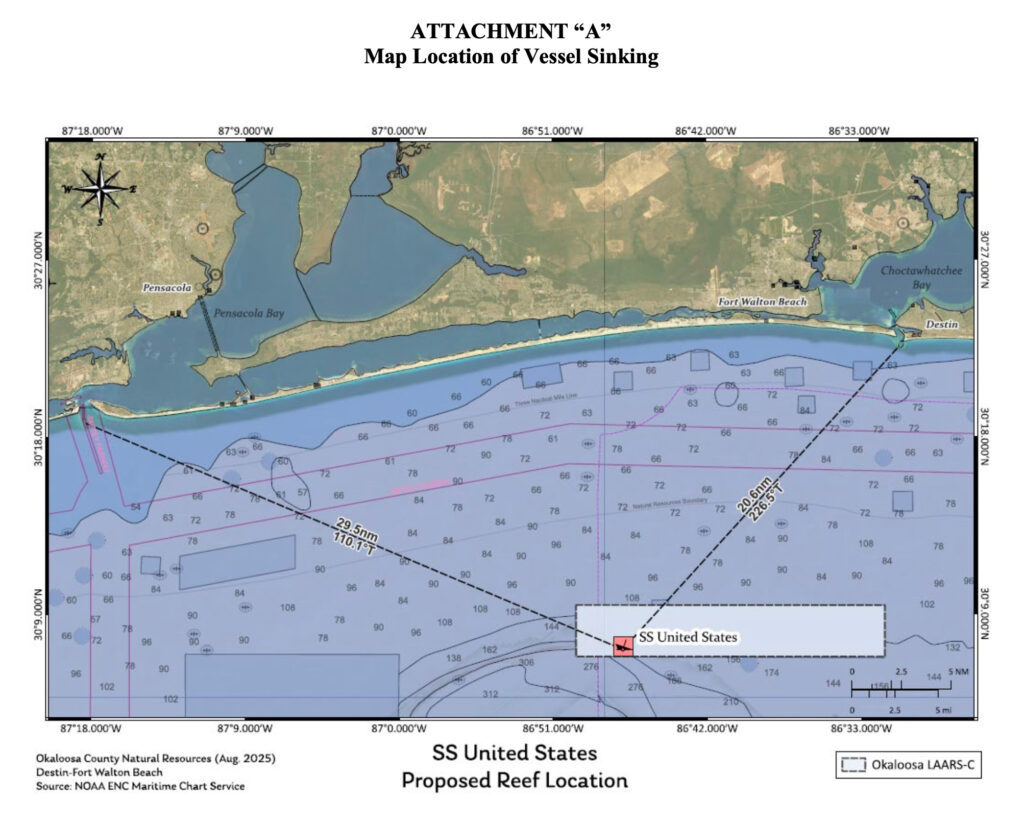
The vessel is scheduled to be deployed in early 2026, approximately 22 nautical miles southwest of Destin Pass and 32 nautical miles southeast of Pensacola Pass. Fogg explained that the deployment location was selected after significant coordination with the military and neighboring communities.
The county conducted side scan sonar surveys and visual dive inspections to confirm the deployment site is clear of historical resources and natural reef formations.
Because artificial reef deployments do not permit the use of explosives, crews will cut holes strategically throughout the ship to allow water to flow through quickly during the sinking process. All fuel tanks will be filled with water before deployment to help balance the ship. A naval architect has developed a digital model of the vessel to determine exactly where holes need to be cut for an efficient and safe deployment.
Fogg outlined a deployment schedule with contingencies built in. The best-case scenario targets the last week of February. If weather or other issues arise, deployment would be pushed back in 30-day increments.
- “It’s one-week periods to allow for a little bit of play with the weather,” Fogg explained. “And again, that safety and security that’s being managed by FWC, Coast Guard and our public safety, there’s so many logistics, so many groups that are coming from around the United States. We can’t just start and stop and start back up again in just three days’ notice.”
Addressing public concerns
Fogg addressed several concerns that have been raised publicly about the project. He noted that the ship’s listing on the National Register of Historic Places does not provide protections against being sunk as an artificial reef unless the vessel were owned by the federal government. Additionally, there is significant effort being made to preserve the ship’s legacy through the museum and other historical documentation.
Regarding environmental concerns, Fogg said the aluminum on the ship is not a concern, as aluminum is commonly deployed in artificial reefs. PCBs have been extensively remediated in coordination with the EPA, which has made two site visits and expressed satisfaction with the work.
On the topic of zinc chromate and hexavalent chromium, which Fogg acknowledged has been “a hot topic recently,” he explained that zinc chromate is not a federally regulated material requiring removal from the vessel. It’s treated similarly to lead and asbestos, meaning it can remain on the ship as long as there is no peeling paint containing the substance.
- “The EPA and the other regulatory agencies that comment on all of these projects have not raised any concerns about hexavalent chromium or zinc chromate,” Fogg said.
Project generating substantial media attention
The SS United States project has generated $184 million in earned media value since November 2024, Fogg reported, with approximately 20 billion impressions in reach.
“Every major news outlet is covering this,” he said. “Numerous documentaries are covering this project, and IMAX has shown interest in this project for a large film that they’re making on shipwrecks. And they actually will begin shooting on the SS United States in the coming weeks.”
Research partnerships have been established with Dauphin Island Sea Lab, Louisiana State University and Woods Hole Oceanographic Institution, which plans to conduct biological, chemical and physical monitoring of the ship for 10 years after deployment.
Commissioner support for the project
Commissioner Trey Goodwin sought clarification about the project’s origins during the meeting.
“Was scrapping of this ship something that it was at significant risk of incurring before the county elected to buy it?” Goodwin asked.
“Yes. I believe that there was actually a company that bid to scrap the SS United States for numerous years leading up to when we took ownership of the vessel for artificial reef purposes,” Fogg replied. “So essentially we saved it from being scrapped.”
Craig Coffey, Deputy County Administrator, added context about the SS United States Conservancy’s decision to sell to Okaloosa County.
- “They actually were offered more money to scrap it, and they chose to go this route because they thought this was a better legacy for the ship,” Coffey said. “They chose us over scrapping, even though they could have done that to financially gain more because they thought it was the better way and they were dedicated to preserving the ship.”
The contract amendment brings the total Coleen Marine contract to $10,178,000 in bed-tax and funding partnerships, which includes $7,228,000 in the original contract amount, $2,766,712 for known identified costs and $183,288 in contingency funding.